Launch offer — valid today only

📄 Digital book in PDF · read it on your phone or print it

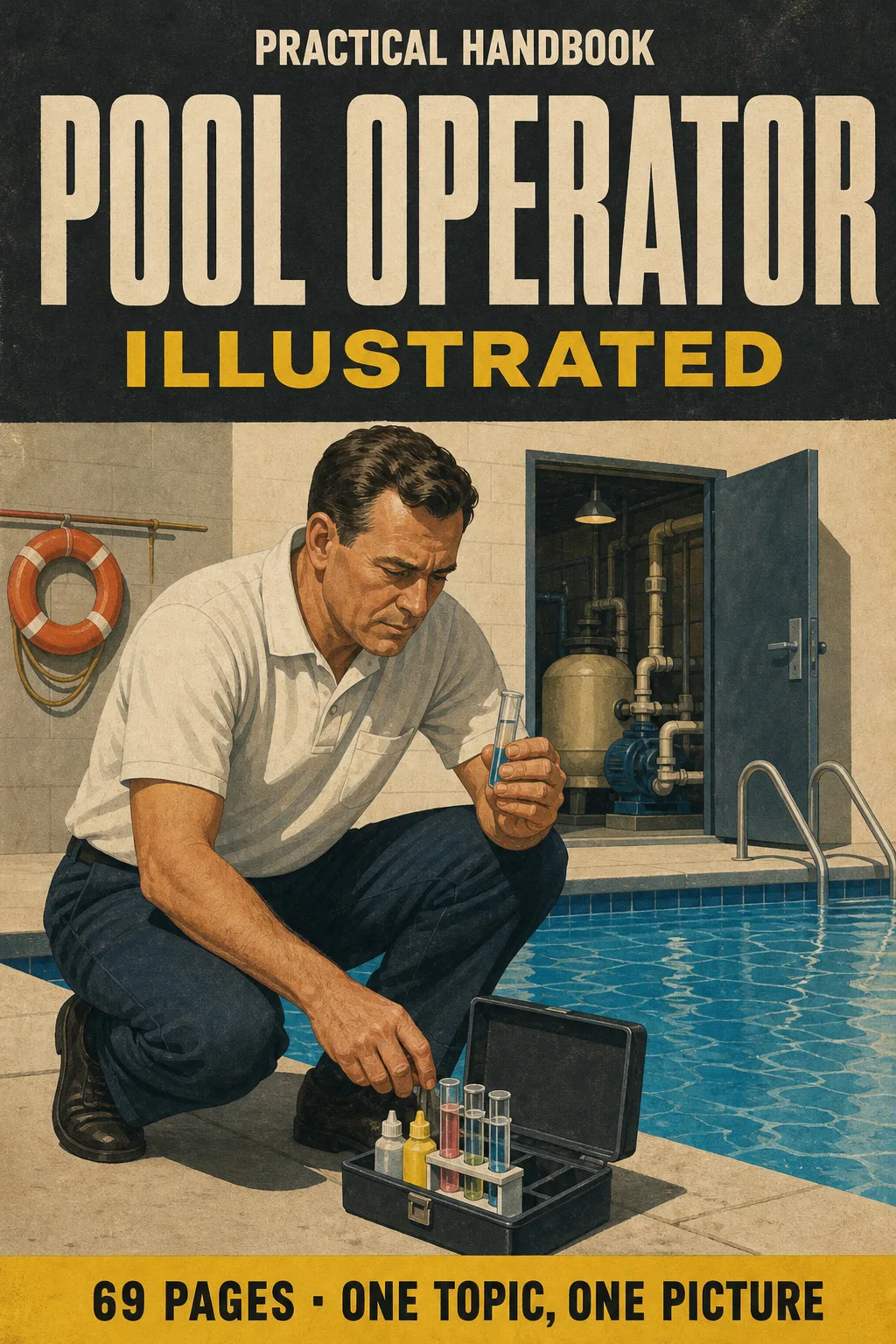
Pool Operator Certification in Drawings: Every Pool Calculation in the Same 4 Steps One Topic on Every Page

The circulation map, pumps and filters, pool math, free and combined chlorine, breakpoint, pH and the saturation index, water testing, entrapment safety and the health inspection. Every topic gets its own page: the drawing first, then what you need to remember. 69 illustrated pages.

START STUDYING THIS WAY

🔒 Secure checkout · PDF by email · 30-day guarantee

Every topic, its own pageEvery system part and every calculation drawn, with the explanation right next to it
69 illustrated pages9 parts, from the circulation map to the questions inspectors ask
Up-to-date sourcesChecked against the CDC MAHC, CDC Healthy Swimming and the VGB Act (CPSC), with every limit flagged to confirm in your state code
PDF by emailFormat

Look Inside the Book

Every page has one big drawing and a box with the ranges, formulas and steps you need to know:

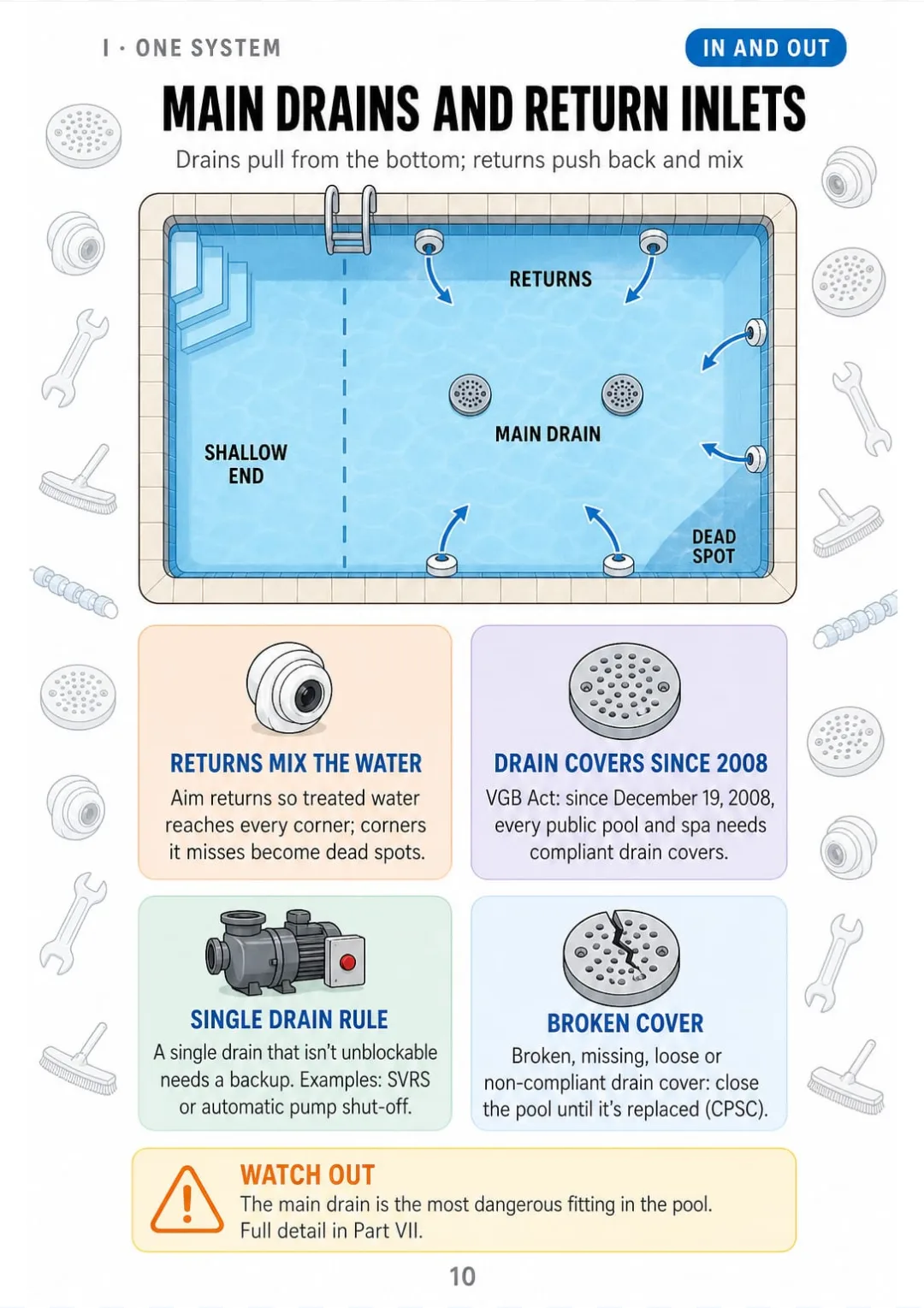
VGB Act: compliant drain covers since Dec. 19, 2008; a broken cover means closing the pool.
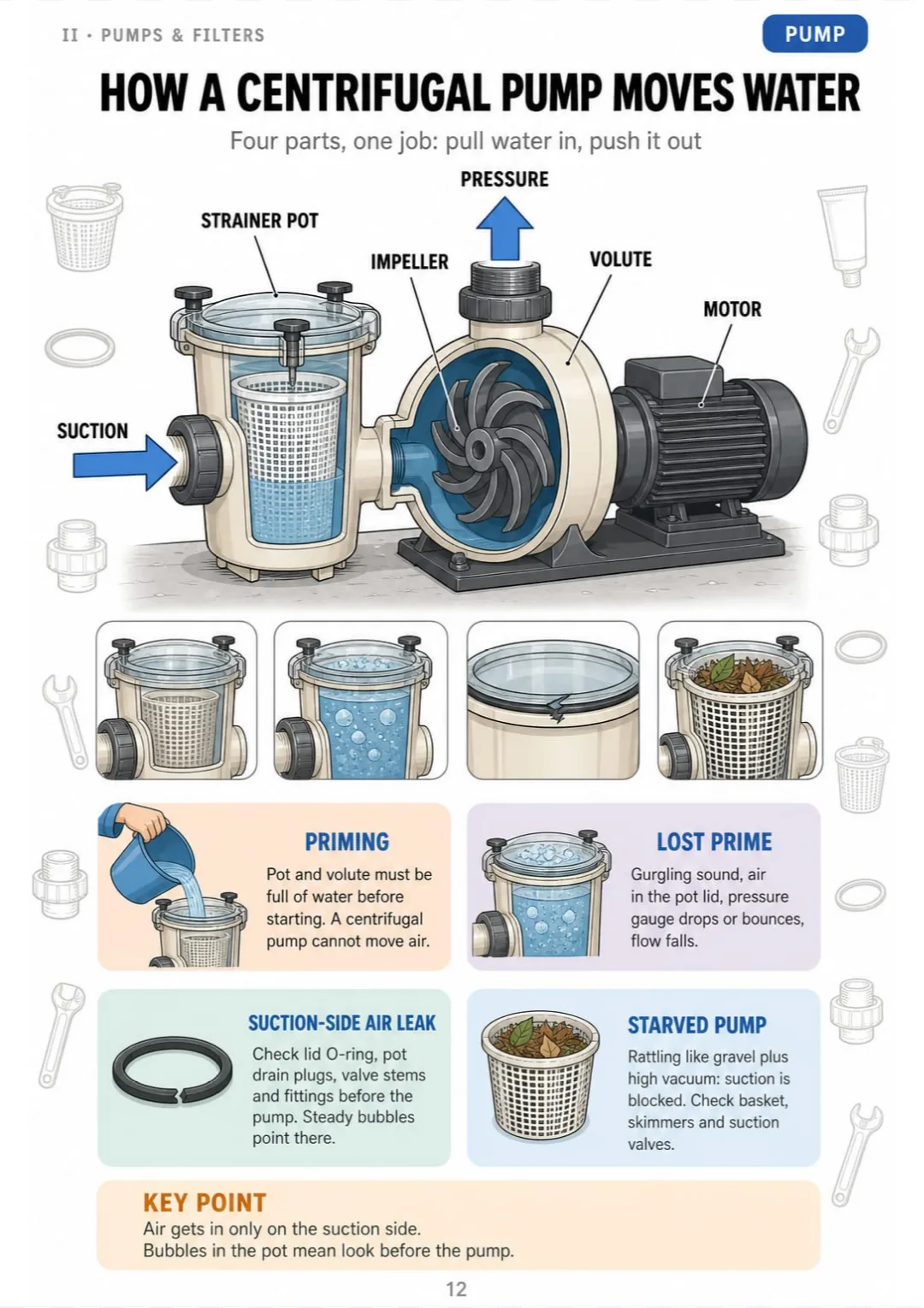
Pump cutaway: strainer pot, impeller, volute, motor, plus the signs of lost prime
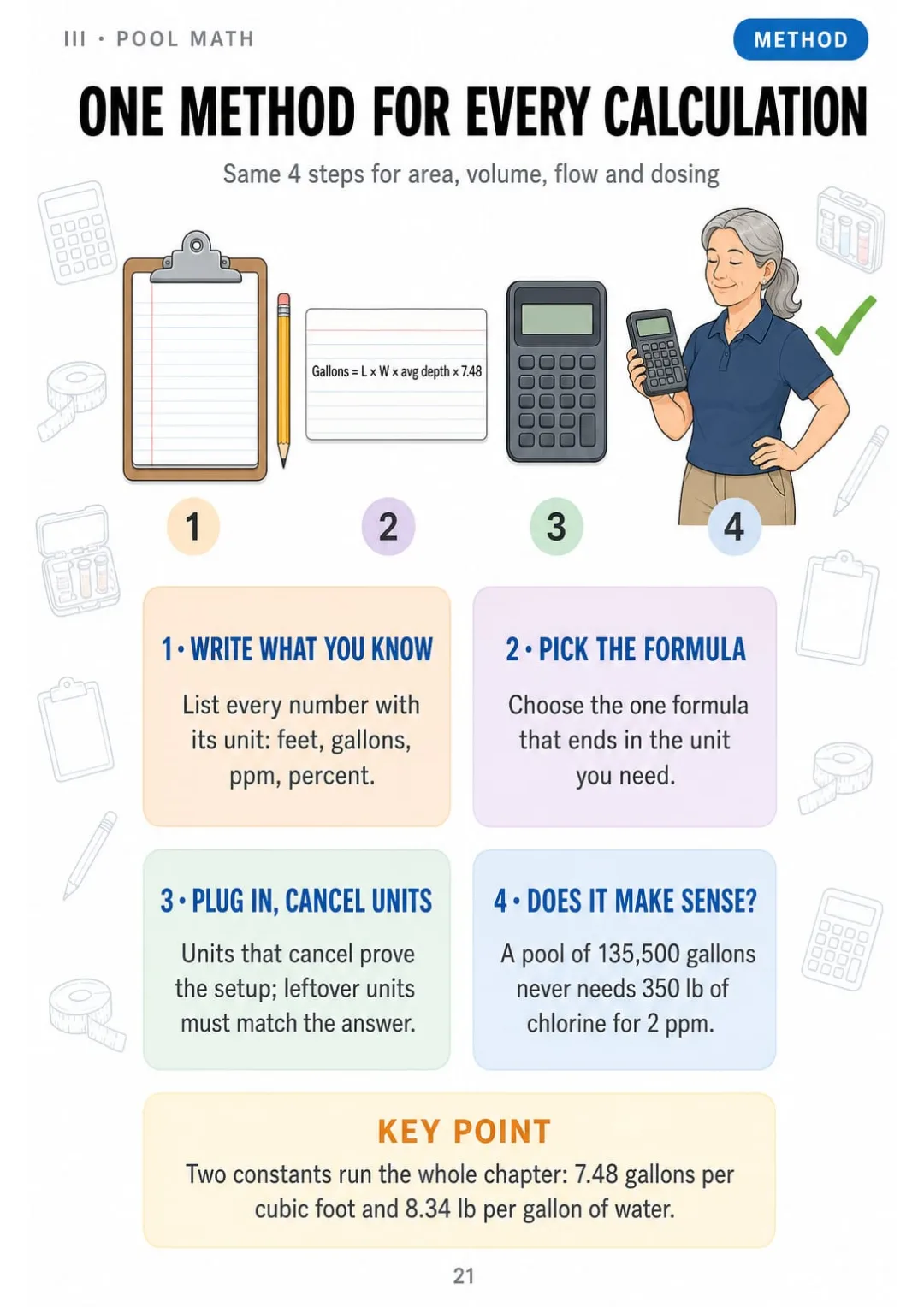
4 steps, always in order: knowns, formula, plug in, sanity check
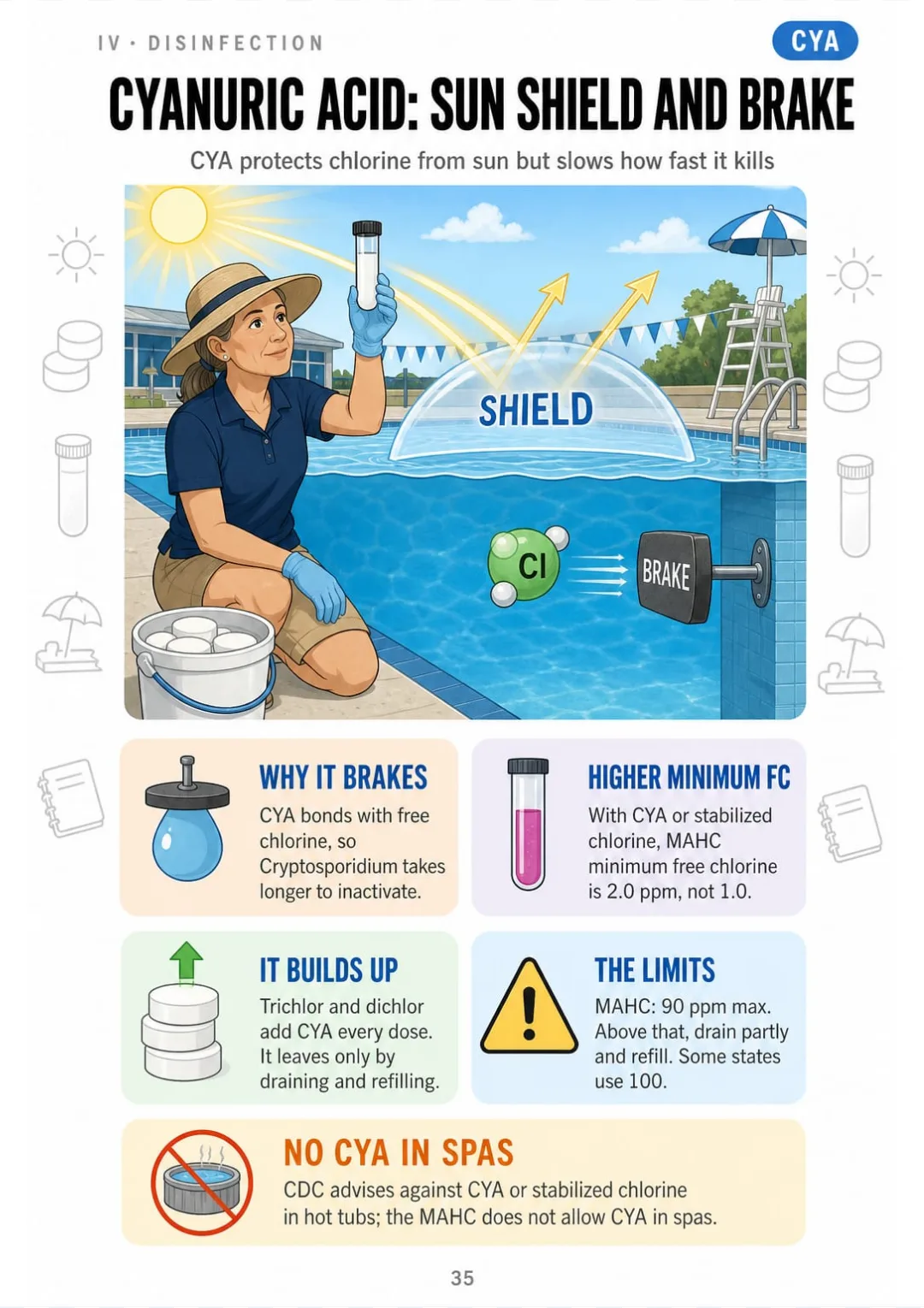
MAHC: CYA max 90 ppm, FC minimum 2.0 ppm when stabilized, no CYA in spas.
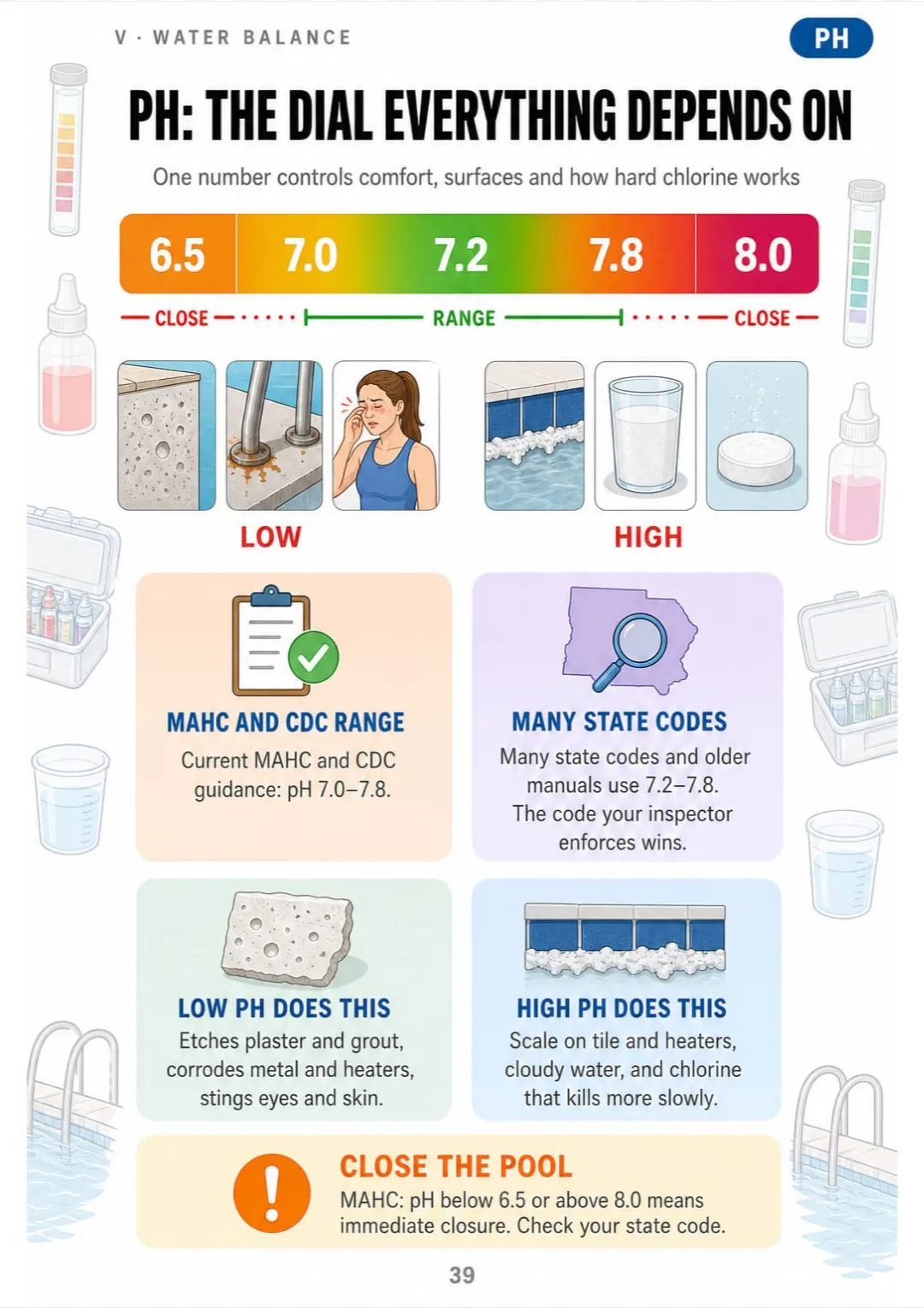
pH range 7.0–7.8 (MAHC/CDC; many states 7.2–7.8) and the two closure limits: 6.5 and 8.0.
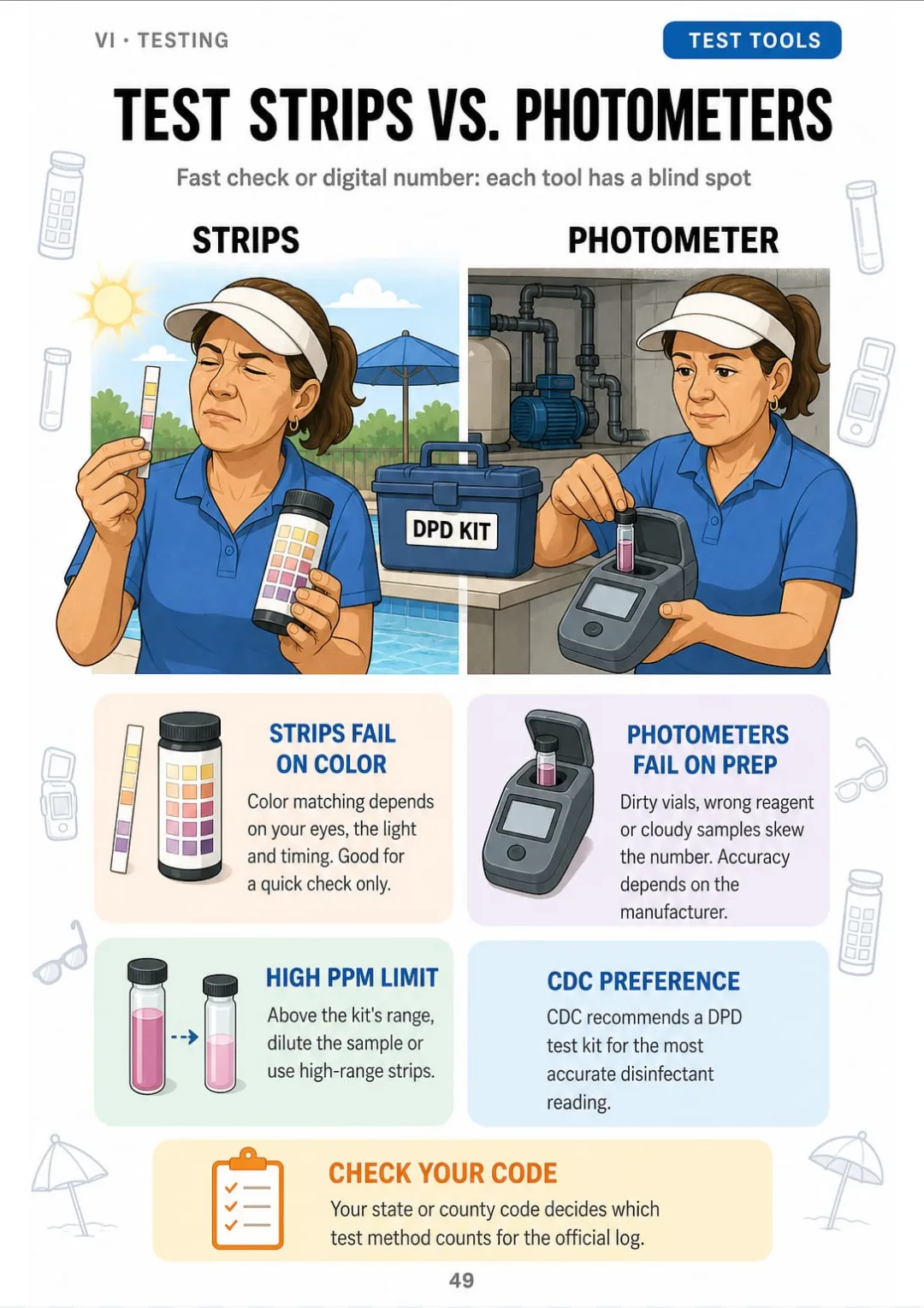
Strips for quick checks, DPD kit for the most accurate reading (CDC); your code sets the log test.
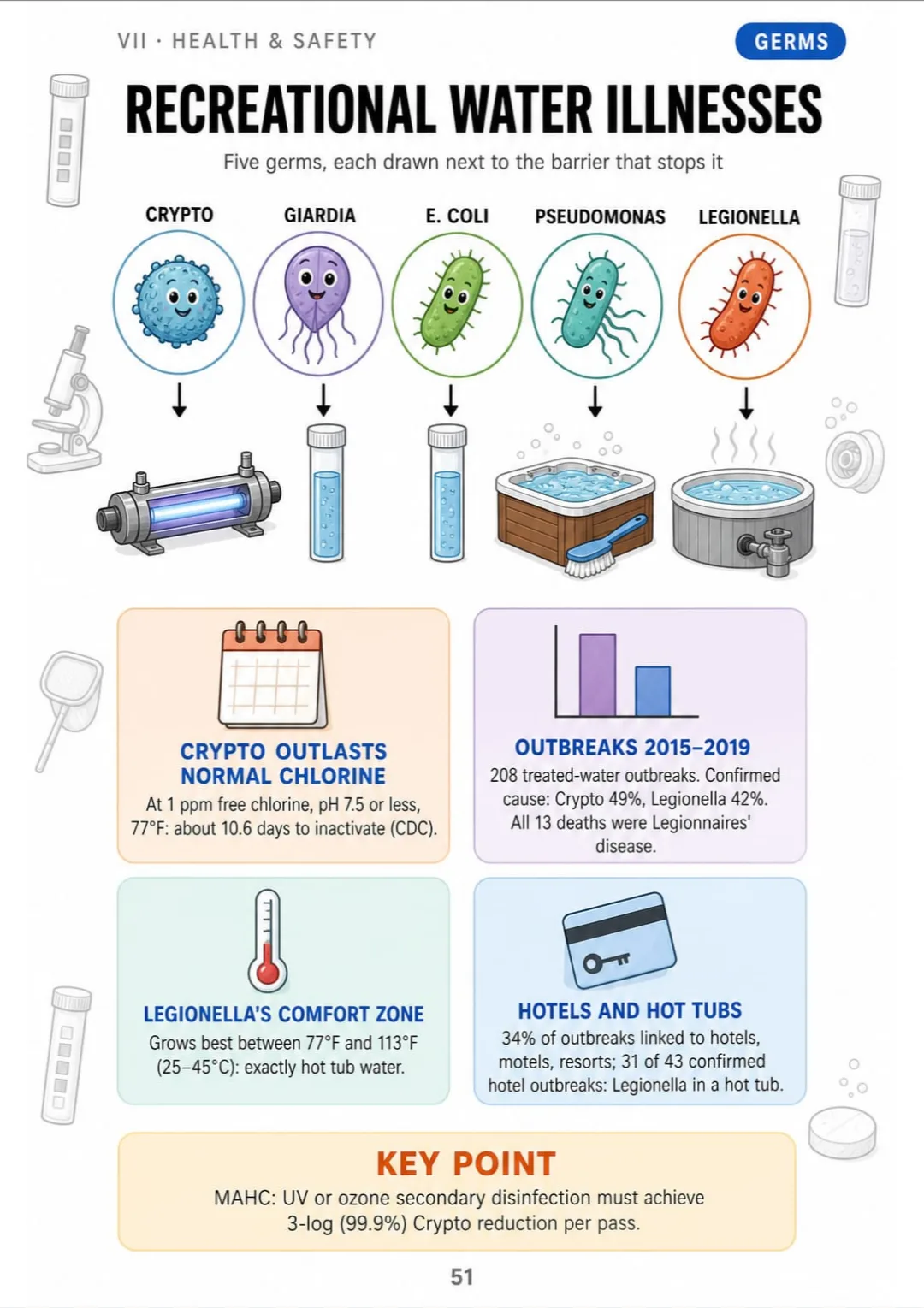
Crypto: about 10.6 days to inactivate at 1 ppm free chlorine (CDC)
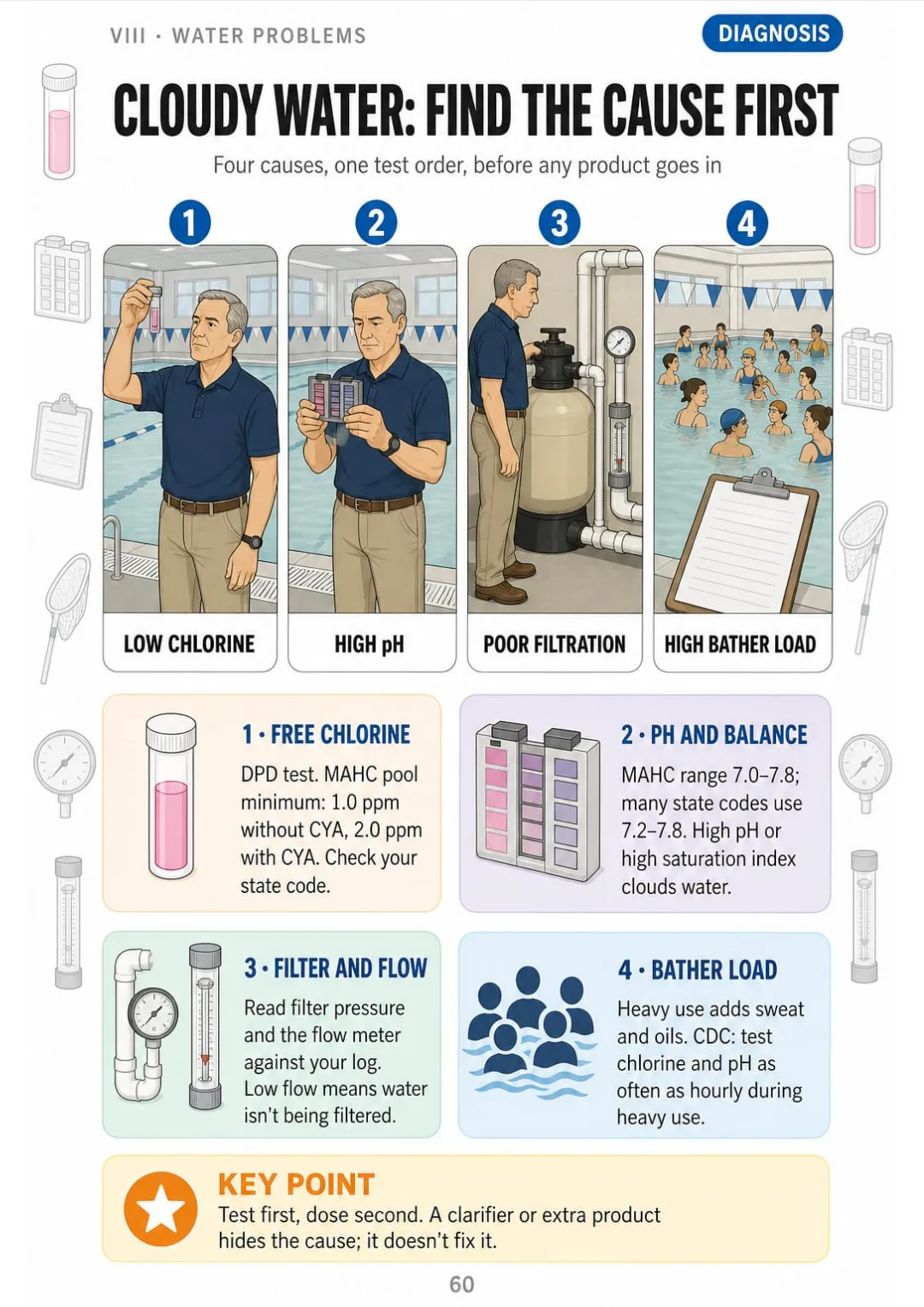
Cloudy water: test chlorine, pH, filter flow and bather load, in that order

Swipe to see more →

These are real pages from the book. The table of contents is the full one: 9 parts and 65 topics.

The Problem Isn't You. It's How It Was Explained to You.

It's day two of the pool operator course. The instructor puts a problem on the board: a 75 by 35 foot pool, 4.5 feet average depth, raise free chlorine by 2 ppm. Everyone starts writing, and you're staring at the numbers.

You read that chapter last night. But the manual walks through each formula in paragraphs, a little differently every time, and nobody tells you where to start.

4 steps, always in order: knowns, formula, plug in, sanity check

In the book, every calculation sits on the same drawing: four boxes, always in order: knowns, formula, plug in, sanity check. That pool? About 88,600 gallons, so roughly 2.3 pounds of 65% cal hypo. Volume, turnover, dosing: the same four steps.

And every other topic gets its own page too: the circulation map, the centrifugal pump, free vs. combined chlorine, pH and the saturation index, cloudy water.

So when the next problem lands in front of you, you write down the knowns and work it through, without flipping back to the manual.

COMPARE FOR YOURSELF

The Same Topic, Two Ways to Study It

THIS
  • The manual: line after line
  • Pumps and priming explained only in words
  • You walk into the exam unsure
Free available chlorine (FAC) comprises hypochlorous acid and hypochlorite ion, whose relative proportions are governed by pH according to the dissociation equilibrium of HOCl. Combined available chlorine (CAC) results from the reaction of free chlorine with ammonia and organic nitrogen compounds introduced by bathers, forming monochloramine, dichloramine and nitrogen trichloride. Total available chlorine is the sum of FAC and CAC. Breakpoint chlorination is achieved when sufficient free chlorine is added to oxidize the combined fraction completely, a dosage commonly estimated at approximately ten times the combined chlorine concentration.
FOR THIS
  • The pump cutaway in one drawing
  • The signs of lost prime in a box
  • You see it and you get it
Pump cutaway: strainer pot, impeller, volute, motor, plus the signs of lost prime
CONTENTS

Take a Look at the 9 Parts and 65 Topics

The pool as one system, pumps and filters, pool math, disinfection, water balance, testing, health and safety, water problems and a final review: 69 pages, all illustrated

IThe Pool as One System · pp. 5-11
  1. The Circulation Map: Every Part in One Drawing
  2. What a Pool Operator Is Responsible For
  3. Who Writes the Rules: CDC, MAHC, State and County
  4. Suction Side vs. Pressure Side
  5. Skimmers and Gutters: Cleaning the Surface
  6. Main Drains and Return Inlets
  7. Valves and Plumbing You Should Know by Sight
IIPumps, Filters and Flow · pp. 12-20
  1. How a Centrifugal Pump Moves Water
  2. Reading the Gauges: Vacuum, Pressure and Flow Meter
  3. Total Dynamic Head and the Pump Curve
  4. Sand Filters: Depth Filtration and Backwash
  5. Cartridge Filters: Surface Filtration
  6. DE Filters: The Finest Filtration
  7. Filtration Rate: Sand vs. Cartridge vs. DE Side by Side
  8. Heaters and Feeders on the Line
  9. Variable-Speed Pumps and Energy Rules
IIIPool Math, Always the Same 4 Steps · pp. 21-29
  1. The 4-Step Method for Every Calculation
  2. Surface Area: Rectangles, Circles and Odd Shapes
  3. Volume in Gallons
  4. Turnover Rate and Required Flow
  5. Parts per Million: What 1 ppm Really Means
  6. Dosing Formula: How Much to Raise Chlorine
  7. Liquid Chemicals: Gallons, Fluid Ounces and Strength
  8. Using a Dosage Chart Without Getting Lost
  9. Dilution and Water Replacement
IVDisinfection: What Happens in the Water · pp. 30-38
  1. Chlorine in Water: Hypochlorous Acid vs. Hypochlorite Ion
  2. Free, Combined and Total Chlorine
  3. Chloramines: The 'Chlorine Smell' Is Not Too Much Chlorine
  4. Breakpoint Chlorination Step by Step
  5. Chlorine Products Compared
  6. Cyanuric Acid: Sun Shield and Brake
  7. Bromine for Spas and Hot Water
  8. Secondary Disinfection: UV and Ozone
  9. ORP Controllers and Automatic Feed
VWater Balance and the Saturation Index · pp. 39-45
  1. pH: The Dial Everything Depends On
  2. Total Alkalinity: The pH Buffer
  3. Calcium Hardness: Too Soft or Too Hard
  4. Adjusting pH: Which Chemical and How Much
  5. The Saturation Index: Corrosive, Balanced or Scaling
  6. Saturation Index Worked Example in 4 Steps
  7. TDS, Water Replacement and Start-Up Water
VITesting and Records · pp. 46-50
  1. Taking a Water Sample the Right Way
  2. DPD and FAS-DPD: Testing Free and Combined Chlorine
  3. Phenol Red, Alkalinity, Hardness and CYA Tests
  4. Test Strips, Photometers and Their Limits
  5. The Daily Log: What to Write and Why
VIIHealth, Safety and the Inspection · pp. 51-59
  1. Recreational Water Illnesses
  2. Fecal and Vomit Incident Response
  3. Entrapment and the Virginia Graeme Baker Act
  4. Chemical Storage: What Never Goes Together
  5. PPE, SDS and OSHA Hazard Communication
  6. Electrical Safety: Bonding and GFCI
  7. Barriers, Signs and Safety Equipment
  8. Spa and Hot Tub Operation
  9. Getting Ready for the Health Inspector
VIIIWater Problems and Seasonal Care · pp. 60-63
  1. Cloudy Water: Find the Cause First
  2. Green, Black and Mustard Algae
  3. Scale, Stains and Metals
  4. Opening and Closing a Commercial Pool
IXReview Before the Exam · pp. 64-69
  1. Every Target Range on One Page
  2. Every Formula on One Page
  3. Full Worked Problem: One Pool from Start to Finish
  4. Most Common Mistakes in Pool Math
  5. Most Common Mistakes in the Pump Room
  6. Questions Inspectors Ask, and How to Answer

One Page, One Topic, All Clear

Think of it this way:

The county inspector is at your pool. He checks the log, tests the water and asks: with pH at 7.8, how well is your chlorine actually working?

In the book you open the page on chlorine in water and see HOCl and OCl⁻ drawn side by side: at pH 7.5 about half your chlorine is the strong killer; at 7.8, only about a third.

pH range 7.0–7.8 (MAHC/CDC; many states 7.2–7.8) and the two closure limits: 6.5 and 8.0.

Same with the circulation map, the pump cutaway, the 4-step math, taking a water sample and cloudy water: each one on its own page.

Pool Operator Illustrated is 9 parts and 65 topics, all drawn, and it ends with every target range and every formula on one page, a full worked problem and the questions inspectors ask.

What you see drawn, you don't have to memorize.

What's Inside Pool Operator Illustrated:

Ipp. 5-11

The Pool as One System

The circulation map, what the operator is responsible for, who writes the rules, suction vs. pressure side, skimmers, main drains, returns and valves.

IIpp. 12-20

Pumps, Filters and Flow

The centrifugal pump, vacuum and pressure gauges, flow meter, total dynamic head, sand, cartridge and DE filters, filtration rates, heaters, feeders and variable-speed pumps.

IIIpp. 21-29

Pool Math, Always the Same 4 Steps

Every calculation solved the same way: knowns, formula, plug in, sanity check. Surface area, gallons, turnover and flow, what 1 ppm means, dosing, liquid chemicals, dosage charts and dilution, so a new problem never starts from a blank page.

IVpp. 30-38

Disinfection: What Happens in the Water

Why the same ppm can work fast or slow: HOCl vs. OCl⁻, free, combined and total chlorine, chloramines and breakpoint, then chlorine products, cyanuric acid, bromine, UV, ozone and ORP controllers.

Vpp. 39-45

Water Balance and the Saturation Index

pH, total alkalinity, calcium hardness, adjusting pH, the saturation index with a worked example in 4 steps, TDS and start-up water.

VIpp. 46-50

Testing and Records

Taking a water sample, DPD and FAS-DPD, phenol red, alkalinity, hardness and CYA tests, strips and photometers, the daily log.

VIIpp. 51-59

Health, Safety and the Inspection

Recreational water illnesses, fecal and vomit response, entrapment and the VGB Act, chemical storage, PPE and SDS, bonding and GFCI, barriers, spas and the health inspection.

VIIIpp. 60-63

Water Problems and Seasonal Care

Cloudy water, green, black and mustard algae, scale, stains and metals, opening and closing a commercial pool.

IXpp. 64-69

Review Before the Exam

Every target range and every formula on one page, a full worked problem, the most common mistakes in pool math and in the pump room, and the questions inspectors ask.

At the end of the book: Every target range and formula on one page, a full worked problem and the most common mistakes in pool math and the pump room.
Plus: 2 Free Books

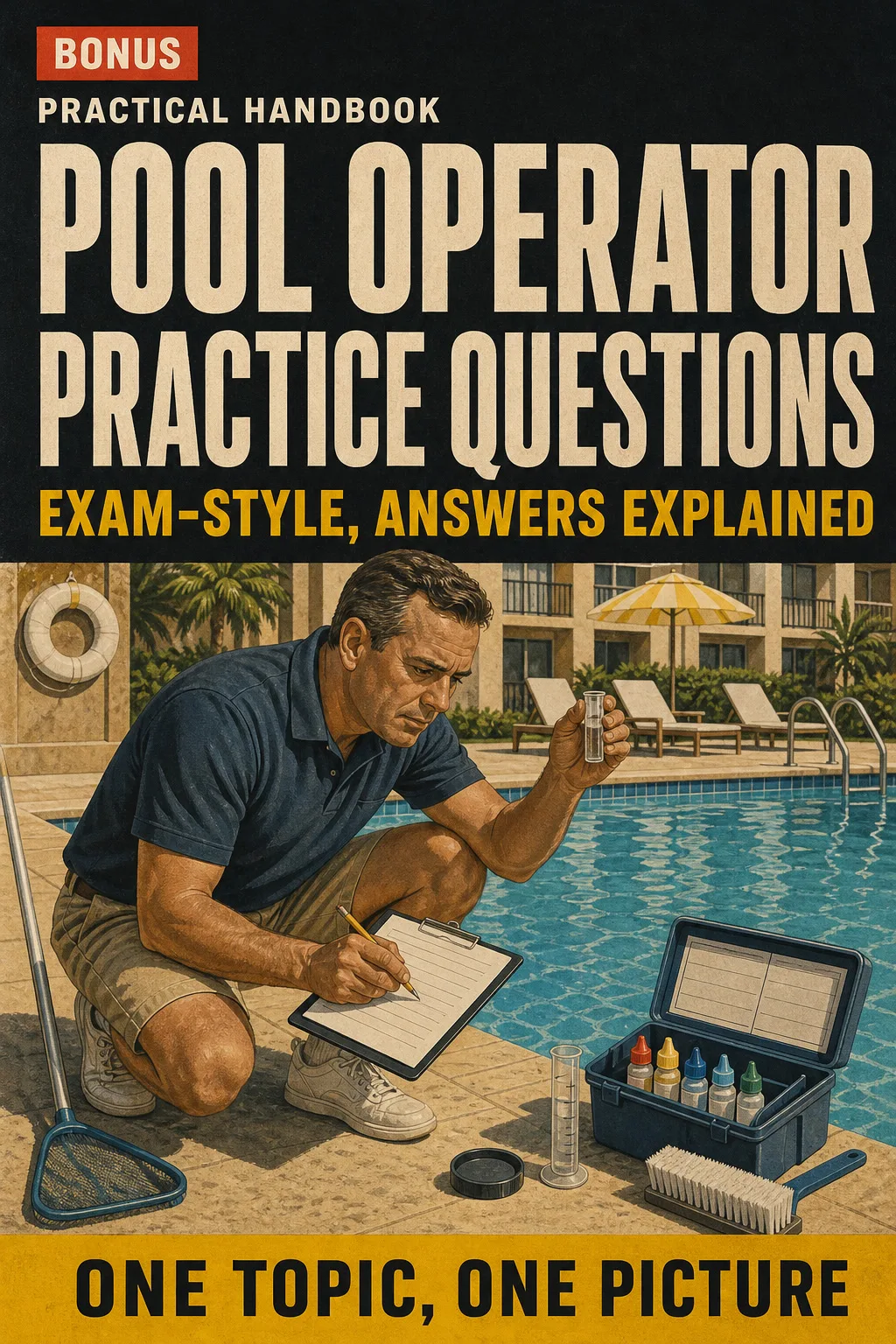
Pool Operator Practice Questions: Exam-Style, Answers Explained

BONUS 1: «Pool Operator Practice Questions: Exam-Style, Answers Explained»

Value on its own: US$ 17.90

Test yourself on chemistry, filtration, math and safety, and see why each answer is right, so nothing on exam day feels new.

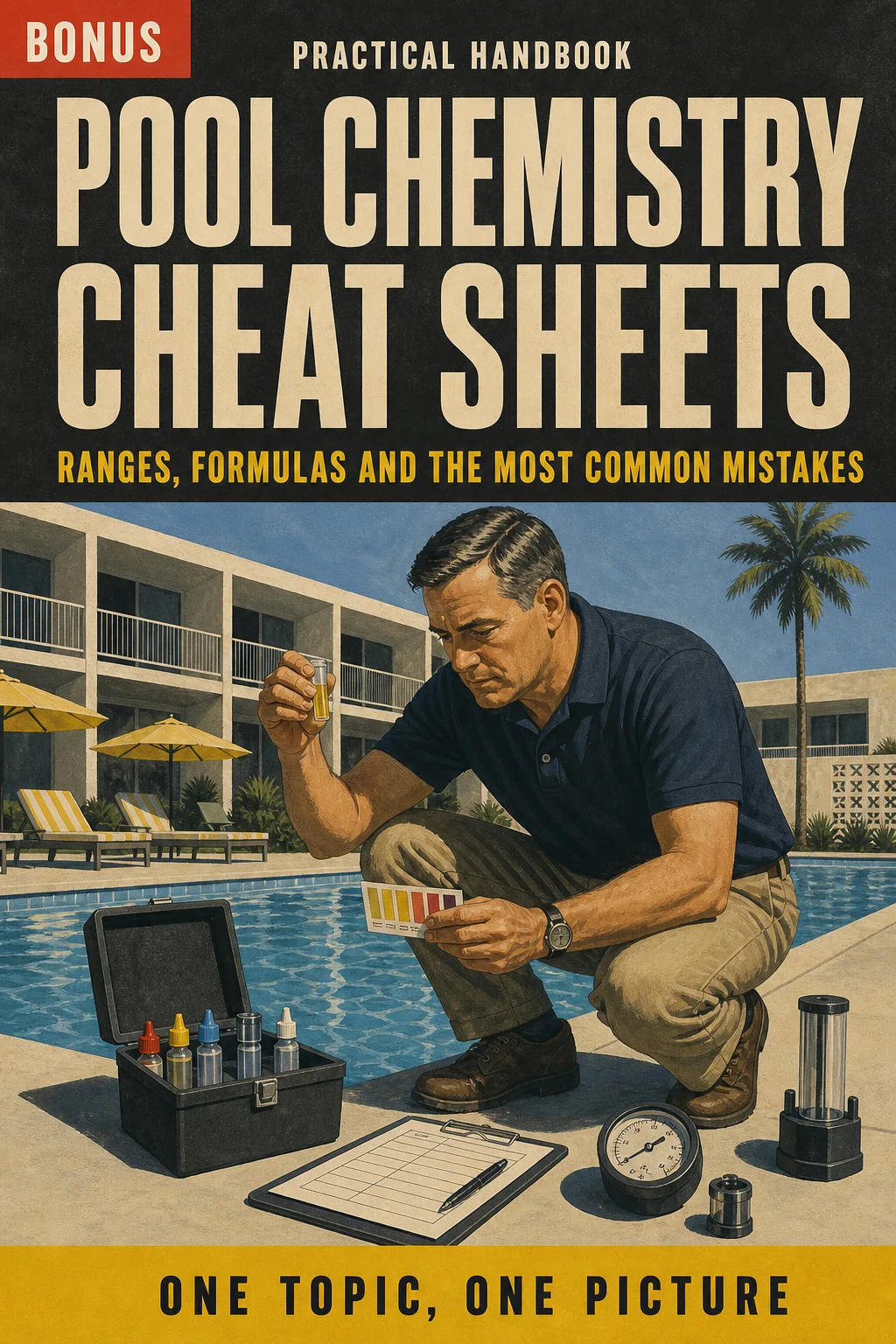
Pool Chemistry Cheat Sheets: Ranges, Formulas and the Most Common Mistakes

BONUS 2: «Pool Chemistry Cheat Sheets: Ranges, Formulas and the Most Common Mistakes»

Value on its own: US$ 14.90

Every target range, formula and common mistake on a few printable pages to keep in the pump room and review in minutes.

Pool Operator Illustrated with 2 Free Books

  • Pool Operator Illustrated: 69 illustrated pagesUS$ 63
  • BONUS 1: Pool Operator Practice Questions: Exam-Style, Answers ExplainedUS$ 17.90
  • BONUS 2: Pool Chemistry Cheat Sheets: Ranges, Formulas and the Most Common MistakesUS$ 14.90
  • High-resolution PDF to printIncluded
Total value US$ 95.80
YOUR PRICE:
US$ 27
You save US$ 68.80
YES, I WANT POOL OPERATOR ILLUSTRATED FOR US$ 27

📄 This is a digital PDF book sent to your email: nothing is printed or shipped.

Secure purchaseEncrypted payment30-day guarantee

PDF by email: We email you Pool Operator Illustrated as a PDF, together with the two free books. It's a single payment: no installments, no extra charges.

Who This Book Is For

You're signed up for the pool operator course

You're signed up for the pool operator course

You show up already knowing how the system connects, from the main drain to the returns, so two days of class make sense from the first hour.

Your exam or renewal is coming up

Your exam or renewal is coming up

Breakpoint, turnover, the saturation index and dosing math, one page each, worked out in the same 4 steps every time so you can review in order.

You already run the pool

You already run the pool

Print it and keep it in the pump room: ranges, gauges and the cloudy-water check order at a glance when the inspector or the manager asks.

Everything You Get Today

US$ 95.80US$ 27
YES, I WANT POOL OPERATOR ILLUSTRATED FOR US$ 27

📄 This is a digital PDF book sent to your email: nothing is printed or shipped.

30DAYS
GUARANTEE

30-Day Guarantee

Try Pool Operator Illustrated for 30 days, bonus books included.

We refund everything if the file won't open, if the book isn't what you see here, if you were charged twice or if the email doesn't arrive. Just email us.

You pay once. No subscriptions.

Frequently Asked Questions

Is this for me if I already work with pumps and filters?

Yes. The equipment pages go fast for you, and the book spends its time where most operators get stuck: chlorine chemistry, water balance and the math. It doesn't replace your course manual: it draws the same topics one per page and works every calculation in the same 4 steps, so you can review in order.

Where does the content come from?

It covers the topics taught in the main U.S. pool operator certification courses and in state or county operator courses, based on the CDC Model Aquatic Health Code (MAHC), CDC Healthy Swimming guidance, the Virginia Graeme Baker Act (CPSC) and OSHA Hazard Communication. State rules differ on some numbers, like the pH range or how often you test, so every range, interval and limit is marked to check against the code your state or county enforces.

Is this official material?

No. It's an independent illustrated study book. It isn't affiliated with or endorsed by PHTA, NRPA, the CDC or any health department or certification body.

Does it replace the certification course?

No. You still take the course and exam your health department requires, and your certificate comes from that course, not from this book. The book doesn't give a certificate or continuing-education credits. It helps you understand the course and review it, one topic per page.

Are the practice questions the ones on the exam?

No. They're exam-style questions written for this book, with every answer explained. They aren't official questions from any exam.

When and how do I get it?

The book and the 2 bonus books come as PDFs by email, to the address you enter at checkout.

Do I have to pay every month?

No. It's a one-time payment.

Can I have it on paper?

Yes. The PDFs are ready to print, so you can keep a copy in the pump room.

How does the refund work?

You have 30 days. We refund everything if the file won't open, if the book isn't what you see on this page, if you were charged twice or if the email doesn't arrive: just email us.

Before You Close This Page

No more rereading with nothing sticking.

The whole circulation system, drawn from the main drain to the returns.

You walk into the exam knowing where everything is.

Drawings make studying faster.

The book is right below.

One-time payment: US$ 27 · Guarantee: 30 days · PDF by email

YES, I WANT POOL OPERATOR ILLUSTRATED FOR US$ 27

📄 This is a digital PDF book sent to your email: nothing is printed or shipped.